
The Default Doctrine
The Problem with Output-First Culture
The prevailing model of performance is simple: do more, push harder, recover later. Output is rewarded. Fatigue is a character flaw. The athlete who trains through discomfort earns the result. This is the Output First doctrine, and it has produced extraordinary performers.
It has also produced extraordinary burnout, chronic injury, hormonal collapse, metabolic dysfunction, and careers cut short by systems that were never allowed to recover.
Output First culture isn't wrong about effort. It's wrong about sequence. It treats physiology as the thing that happens after training, as recovery, rather than the thing that makes training possible in the first place.
Performance 3.0 begins here: with the recognition that sustainable output is downstream of biological governance, not upstream of it.
Failure Pattern
- Escalation without governance
- Symptom chasing instead of system assessment
- Chronic strain masked by motivation
- Interventions layered onto unresolved constraints
First Principles
The Biological Reality of Adaptation
The human body adapts to imposed demand, but only when three conditions are met: sufficient stimulus, adequate recovery, and available biological resources to execute the adaptation.
When any of these three conditions is absent, adaptation stalls. The body continues to absorb the stimulus, but it cannot convert that stimulus into improved capacity. This is the physiological definition of a plateau, not a training problem, but a biological one.
Most coaching addresses the stimulus. It manipulates volume, intensity, frequency, and periodization. These are valid levers. But they operate on the assumption that the body has the biological substrate to respond.
When it doesn't, when recovery systems are dysregulated, when metabolic resources are depleted, when hormonal architecture is compromised, more stimulus produces more stress without more adaptation. The athlete trains harder and goes backwards.
Biological adaptation must be governed, not assumed.
The adaptation sequence
The Hidden Metric
Allostatic Load as the Governing Variable
Operational Definition
Allostatic load is the cumulative biological cost of adapting to chronic and acute stressors, the net physiological toll of all demand placed on the system across every domain of life.
Training adds allostatic load. Sleep debt adds allostatic load. Psychological stress adds allostatic load. Nutritional insufficiency, environmental toxins, travel, conflict, and chronic low-grade inflammation all add to the same account.
The body does not distinguish between sources of load. It only registers total demand against total adaptive capacity. When demand exceeds capacity consistently, the load becomes chronic, and chronic allostatic load is the biological root of performance decline, accelerated aging, hormonal disruption, digestive dysfunction, and systemic fatigue.
High performers accumulate load faster than most. The same drive that produces achievement also eliminates the psychological permission to recover. The result is a system running under persistent surplus demand, depleting the biological reserves that make extraordinary performance possible.
Performance 3.0 tracks allostatic load as a primary governance variable, not a secondary wellness concern.
Baseline drift is the diagnostic distinction.
When Systems Fail
The Four Conditions of Escalation
If one domain destabilizes, escalation is premature.
The Theory of Constraints, Applied to Physiology
The Dominant Constraint Doctrine
Eliyahu Goldratt observed that every system has a single dominant constraint, one bottleneck that limits the output of the entire system.
Strengthening any part of the system that is not the constraint produces no net improvement in system output. Only addressing the constraint moves the system forward.
This principle applies with precision to human physiology. When sleep architecture is the dominant constraint, optimizing nutrition produces marginal returns. When cortisol dysregulation is the dominant constraint, training harder deepens the dysfunction.
When gut permeability is compromising nutrient absorption, increasing dietary quality has limited downstream impact. The dominant constraint is the reason well-designed programs fail on people who are doing everything right.
The program is sound. The physiology is the limiting variable, and it is usually one specific system, not all of them at once.
Constraint Logic
Sequencing is the advantage
- 1Identify the dominant constraint
- 2Correct it
- 3Reassess stability
- 4Escalate only when stable
The Operating Model
Governance in Practice (Sherpa Ecosystem)
Training
- Stimulus is sequenced against current adaptive capacity, not arbitrary periodization schedules
- Load is escalated only when biological readiness markers confirm the system can absorb it
- Volume and intensity are adjusted in response to HRV trends and recovery data, not calendar days
Recovery
- Sleep architecture, not just duration, is monitored as the primary anabolic window
- Recovery protocols are matched to neuroendocrine state, not generic rest-day templates
- Parasympathetic restoration is treated as a training variable, not a passive outcome
- Deload timing is determined by biomarker trends, not perceived fatigue alone
Nutrition
- Dietary strategy is built around metabolic lab data, not macro templates or population averages
- Nutrient timing is coordinated with cortisol curve and training windows
- Micronutrient sufficiency is confirmed before adding performance-layer supplementation
- Energy availability is assessed relative to training load, not body composition targets in isolation
Biomarkers
- Comprehensive labs form the diagnostic foundation: metabolic, hormonal, inflammatory, digestive, and nutrient panels
- Biomarker trends over time reveal adaptive trajectory, not just single-point-in-time status
- Lab interpretation is contextual: values are read against training load, stress history, and recovery quality
Behavioral Signals
- Subjective data, mood, motivation, libido, cognitive clarity, are treated as early-warning governance signals
- Behavioral patterns are mapped against lab cycles to identify leading indicators of system stress
- Lifestyle variables including work stress, travel, and sleep disruption are factored into load calculations
Adaptive Governance Index
The Allostatic Governance Index
AGI does not optimize. It governs.
The Adaptive Governance Index is a composite biological score that reflects the current relationship between allostatic load and adaptive capacity, the ratio of demand to resource at the system level. It is not a performance metric. It is a governance instrument. Its function is to determine what the system can absorb, and what it cannot, at any given moment in a training cycle.
AGI is calculated from objective biomarkers across metabolic, hormonal, inflammatory, digestive, and nervous system domains. It is read in the context of training load, stress history, and recovery quality, not as an isolated number, but as a directional signal. A rising AGI permits escalation. A falling AGI demands restraint. A stable AGI at low capacity demands investigation before any escalation is considered.
Allostatic Load Progression
Behavioral Strain
Early-signal disruption in mood, motivation, sleep quality, libido, and cognitive clarity. These are the first indicators that allostatic load is accumulating beyond the system's current capacity to regulate.
Physiological Deviation
Measurable shifts in biomarkers: cortisol curve disruption, HRV suppression, inflammatory marker elevation, hormonal axis compression. The biology is now reflecting what behavior first signaled.
Structural Consequence
Entrenched dysfunction across one or more physiological systems. Tissue breakdown, neuroendocrine dysregulation, metabolic suppression. Recovery timelines extend from weeks to months. Prevention at layer one is always preferable to intervention at layer three.
Decision States
Escalate
System capacity exceeds current demand
Maintain
Adaptive capacity is matched to load
Reduce Density
Early deviation detected, protect capacity
Deload
Structural stress present, restore before escalating
At Sherpa Frontier, the AGI is the governing variable of every coaching engagement. It determines sequence, intensity, and the decision to escalate or consolidate at every stage of the program. It is not a number to be maximized, it is an instrument through which Performance 3.0 becomes operational. This is not a philosophy about effort. It is a science of sequence, governed by biology, and confirmed by data.
The Sherpa Frontier approach
The Physiology Pyramid
Most programs focus on macros, motivation, or training volume. Sherpa Frontier goes deeper, to the cellular and systemic drivers of performance. This is physiology-first work for everyday athletes, disciplined movers, hybrid athletes, and high performers who train hard but feel capped.
Performance is built on six interconnected physiological pillars. Each tier depends on the one beneath it, which is why we read the base first.
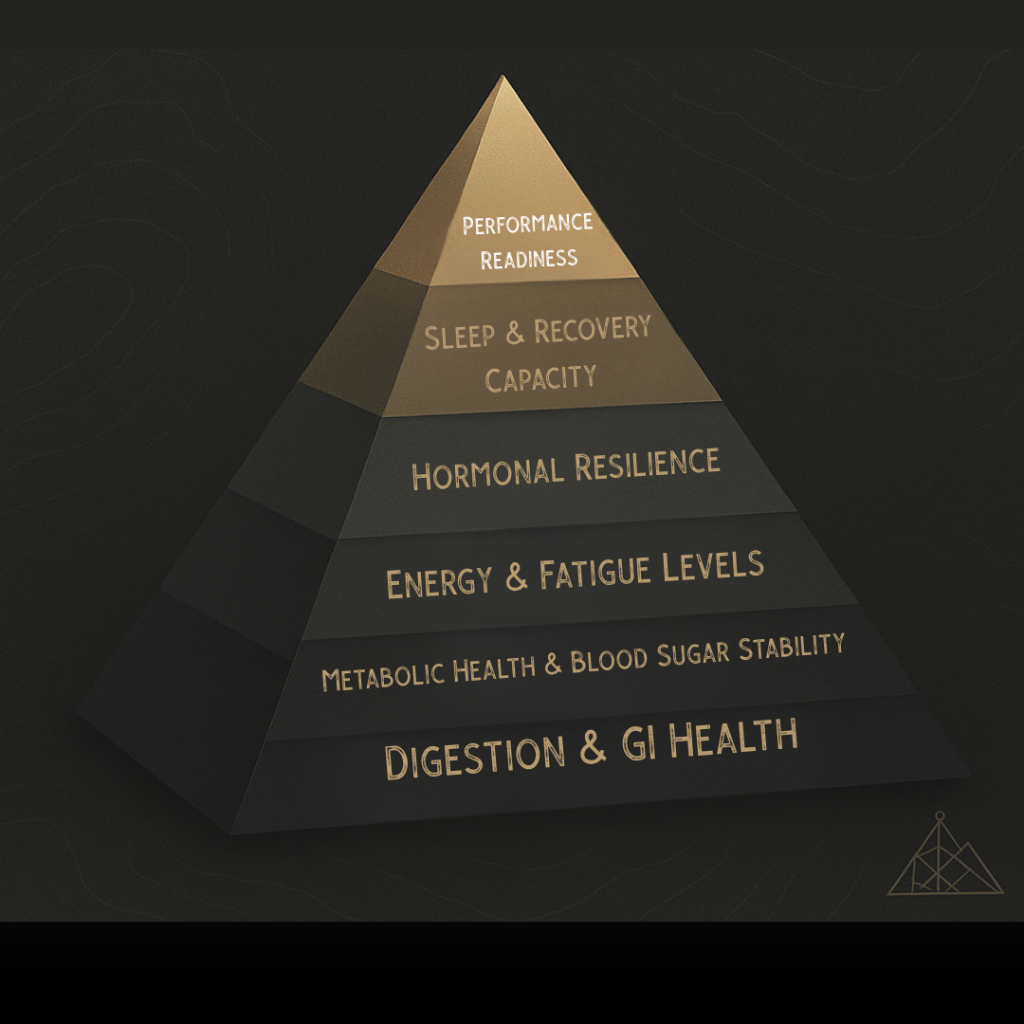
- 6Performance ReadinessThe summit. When the five foundational tiers are aligned, your system is prepared to perform on demand: strong, stable, and repeatable under stress.
- 5Sleep & Recovery CapacityWhere the adaptations actually happen. Deep, high-quality sleep and true recovery capacity are what turn training into progress, not just soreness and fatigue.
- 4Hormonal ResilienceThe long-term regulator of performance, composition, and recovery. Sex hormones, thyroid, and stress hormones must be resilient, not just 'within range', for you to push without breaking.
- 3Energy & Fatigue LevelsHow your physiology feels day to day. Mitochondrial capacity, adrenal signaling, and metabolic flexibility decide whether you have 'another gear' or feel capped early.
- 2Metabolic Health & Blood Sugar StabilityYour engine. From glucose regulation to insulin sensitivity, this tier determines whether your body can deliver consistent, stable energy instead of crashes and swings.
- 1Digestion & GI HealthThe base of everything. If you aren't breaking down, absorbing, and tolerating what you eat, you can't fuel training, recovery, or hormonal balance.
Put the doctrine to work.
Sherpa implements biological governance across training, recovery, nutrition, and labs so escalation stays adaptive. It starts with your bloodwork.